
Stored energy, ready for when it is needed.
A home battery is a rechargeable unit connected to the home's electrical system, usually fixed to a wall indoors or outside. It charges from the grid, from solar panels, or both, and releases that electricity later.
Two numbers describe a battery. Capacity, in kilowatt-hours (kWh), is how much energy it can hold. Power, in kilowatts (kW), is how quickly it can charge or discharge.
A little energy is always lost between charging and discharging. The glossary explains these terms in more detail.
For the grid, batteries in many homes can act as a buffer: taking in energy when there is plenty and easing demand when it is scarce.
Charge when it is plentiful, discharge when it is scarce.
A battery's value to the grid comes from timing. A typical daily pattern looks like this, always within limits the household sets.
Charge at quieter times.
Overnight, or when solar panels produce more than the home uses, the battery fills up while demand on the grid is lower.
Keep a reserve.
Many battery systems let the owner set a minimum level of charge that the battery always keeps back for the home.
Discharge at busy times.
When demand is high, often in the early evening, the battery supplies the home so it draws less from the grid.
Respond to the grid.
Where programmes exist, a battery can charge or discharge when the local grid operator needs help balancing supply and demand.
How a battery can fit with the Olmack system.
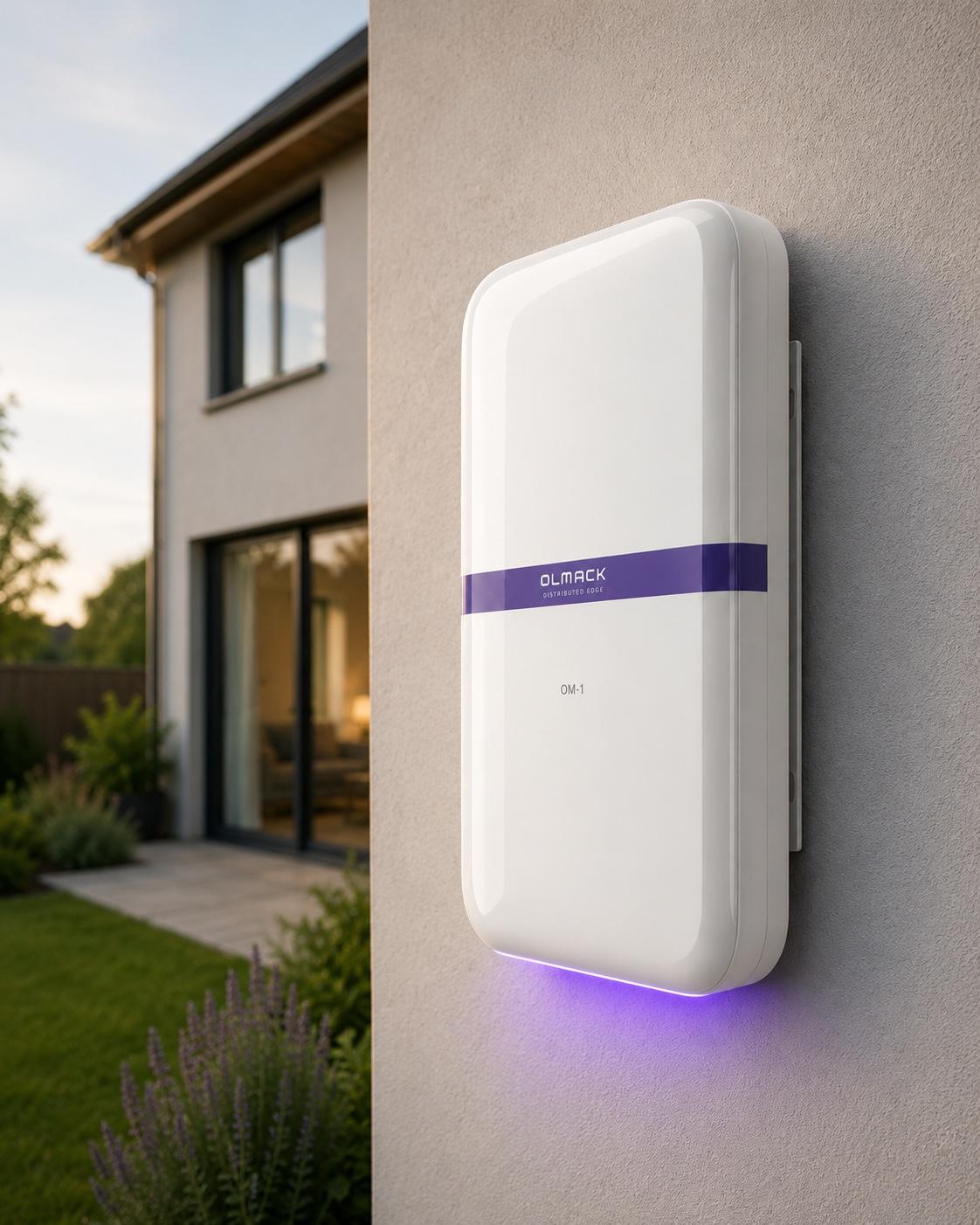
Olmack brings compatible energy equipment, monitoring and communications into one managed platform. The OM-1 unit is the on-site part of that system, mounted on the outside wall of the home.
Olmack is designed to work alongside compatible equipment; ask us whether yours is supported. Where a battery is supported, the aim is to give households and building managers more visibility and control over how stored energy is used.
Read how the Olmack platform brings monitoring and equipment together.
What a battery means for homes and organisations.
The same equipment serves different goals depending on who looks after it.
For a household.
A battery can help you use more of your own solar, and gives you choice over when stored energy is used.
Olmack for homesFor housing providers.
Batteries across many homes can be monitored together, helping managers understand energy use across a portfolio over time.
Olmack for housing providersFor schools.
A battery can help a school spread its energy use across the day, with readings that make that use visible.
Olmack for schools
What to check before installing a battery.
Put safety at the centre.
Batteries hold a lot of energy. They must go in a suitable place, following the manufacturer's instructions and local safety standards.
Use a qualified installer.
Connecting a battery to your home's electrics is skilled work. Choose an installer qualified for battery storage where you live.
Tell the grid where required.
In many places, adding a battery means notifying your local grid operator or getting approval. Installers can often arrange this.
Think about space and location.
Batteries need space, airflow and protection from extreme temperatures. Your installer will advise on a suitable spot.